Rendered in C++Schwarzschild metricNull geodesic integration
Interactive Black Hole Renderer
A C++ ray tracer for Schwarzschild spacetime. One photon geodesic per pixel, integrated until it hits the disc, crosses the horizon, or escapes.
Why it exists
Black holes are cool, and this one started as a wallpaper for a phone. Nothing already out there was quite right, so the first version got written in JavaScript, in high school, where a single frame took thirty minutes. What is on this page is that program rebuilt in C++, done because rebuilding it was fun.
Rays that bend
An ordinary ray tracer asks what a straight line hits. Here there are no straight lines to cast. The camera fixes a photon’s position and wavevector, and from there every pixel is an initial value problem: integrate the geodesic equation forward and see where the ray ends up.
The state is four Schwarzschild coordinates and four wavevector components.
BlackHole::deriv writes the Christoffel terms out longhand, so one derivative
costs a couple of dozen multiplications and the integrator can afford to call
it constantly.
Where the step gets small
The integrator is Dormand–Prince 5(4). Six derivative evaluations build the fifth-order step, which is the answer. A seventh, taken at the far end of it, builds an embedded fourth-order step, and the distance between the two is the error estimate. Dormand–Prince is first-same-as-last, so that seventh evaluation is exactly the one the following step opens with.
The estimate is a max-norm over the position and wavevector components,
divided by the size of the result so the tolerance means something relative.
Under tolerance the step is kept and the next is scaled by
0.8·(tol/err)^0.2, held between four fifths and five times. Over tolerance
the step is discarded and retried shorter, down to a fifth.
None of that knows anything about black holes. But a ray grazing the photon sphere turns hard, its error estimate climbs, and the controller keeps shortening the step until it can follow the curve. The same ray crossing empty space takes strides. Nobody told it to spend its time near the hole; that falls out of the error estimate on its own.
Where the pixels get spent
The same trick, one dimension up. Rays are the expensive thing and most of a frame is flat, so the renderer tries not to cast where the answer is already determined by its neighbours.
Each 64×64 tile splits recursively into quadrants, eight levels deep. Before a
quad splits it gets probed at four corners, four quarter-points, and every
other pixel along its edges. If those all agree on colour to within 1e-3 and
agree on what became of the ray, the quad is filled flat and its interior is
never traced. At depth eight it stops arguing and traces every pixel.
Tiles come off an atomic counter, one worker per hardware thread. The tiles full of empty sky finish almost instantly and their threads move on to the ones near the disc edge, which is where the frame is actually difficult.
What is actually in the picture
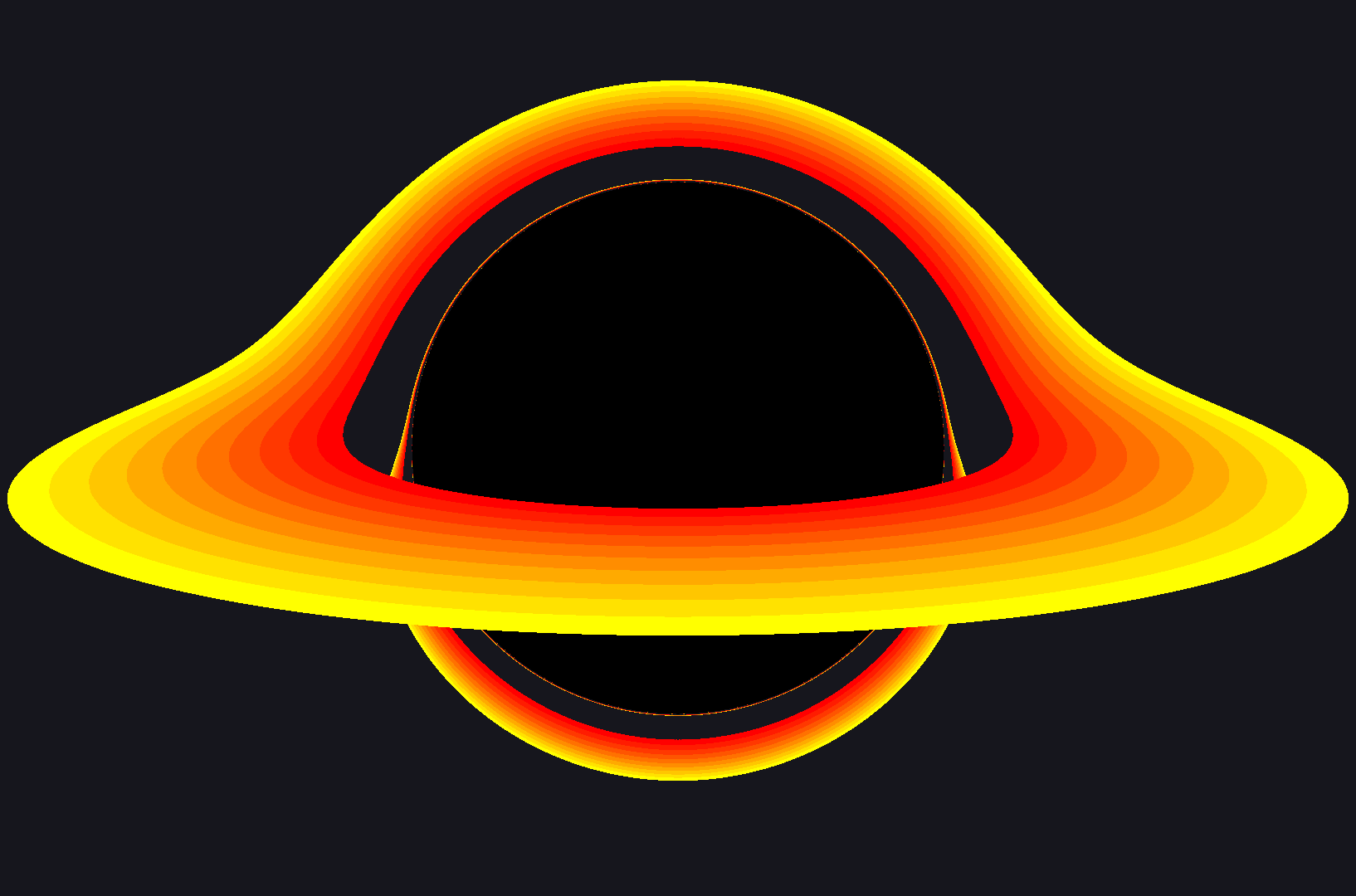
The black shape is not the event horizon. It is the shadow, and it is wider: light aimed within b = 2.598 rs of the centre spirals in and never reaches the camera, so the silhouette is set by that critical impact parameter. The horizon itself sits at rs, well inside it.
Hugging that silhouette is a bright hairline a pixel or two wide, and it is the best thing in the render. That is the photon ring: disc light that came in close enough to loop the hole once or more before escaping toward the camera. The photon sphere it grazes sits at r = 1.5 rs, but its image lands out on the shadow’s edge at 2.598 rs, because that is the impact parameter such a ray leaves with. The two radii in the apparatus below are one feature measured in two places.
The disc lies flat in the equatorial plane, running from rs + 2 out over a width of 4. It appears three times: directly, as the arc lensed up across the top, and as the band bent under the bottom. Light that wraps further than that lands in the photon ring, where the higher-order images stack too tightly to tell apart.
The stripes are real. createAccretionDisk builds the disc from concentric
rings, with a fill fraction for the gaps and a colour ramp running red at the
inner edge out to yellow. Ray-disc intersection is skipped entirely unless the
step crossed the equatorial plane, which is a cheap test that rejects almost
every step.
The sky is one flat colour, #16161d. There is no star field behind the hole,
so everything lit in the frame is the disc, seen either directly or after
being wrapped around.
Reduced far enough to read
The renderer integrates the full geodesic equation. Restricted to the orbital plane and rewritten in u = 1/r, those four coupled equations collapse into one:
Delete the u2 term and what is left describes a straight line in polar coordinates. It is negligible while the ray is far out and takes over the moment it is not, which accounts for every bend in the render above.
The diagram at the top of the page integrates Eq. 1 directly, in TypeScript, for a fan of rays. Light aimed inside the critical parameter spirals in and does not return. Anything outside it leaves, however sharply it was bent on the way.